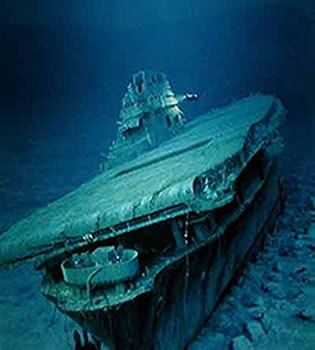
More than three miles beneath the surface of the Pacific Ocean, where sunlight cannot reach and pressure crushes nearly everything that dares to descend, the wreck of the USS Yorktown (CV-5) lies in silent, eternal darkness. Resting at an unimaginable depth of over 5 kilometers, this legendary American aircraft carrier remains frozen in time, surrounded by cold water, drifting particles, and the endless quiet of the deep sea. It is one of the most haunting underwater war relics ever discovered—an iron giant that once ruled the skies above the ocean, now swallowed by the abyss below it.
The USS Yorktown was not just another warship. It was a symbol of American naval strength during one of the most critical periods in modern history: World War II. Commissioned in 1937, Yorktown quickly became a key piece of the United States Navy’s growing carrier fleet. At the time, aircraft carriers were changing warfare forever. Battleships had once dominated the oceans, but the ability to launch aircraft across vast distances meant carriers could strike without warning, far beyond the horizon. Yorktown represented this new era—fast, powerful, and capable of projecting force across the Pacific.
By 1942, the Pacific Ocean had become the center stage of a brutal struggle between the United States and Imperial Japan. After the shock of Pearl Harbor, America was racing to defend its territories and stop Japan’s rapid expansion. In those early months of war, every ship mattered, and every carrier was priceless. Yorktown played a crucial role in several important operations, proving itself again and again as both a weapon and a lifeline for American forces.
One of Yorktown’s most significant moments came during the Battle of the Coral Sea in May 1942. This historic clash became the first naval battle in which the opposing fleets never directly saw each other. Instead, aircraft launched from carriers fought the battle in the skies, delivering bombs and torpedoes while the ships remained far apart. Yorktown’s planes attacked enemy vessels and helped blunt Japan’s advance toward Australia. Though the battle was costly and Yorktown suffered damage, it demonstrated that the era of carrier warfare had truly arrived.
But Yorktown’s most legendary chapter would come just one month later at the Battle of Midway in June 1942—often considered the turning point of the Pacific War. At Midway, American forces faced a Japanese fleet that appeared stronger on paper, with more carriers and aircraft. Yet the U.S. Navy had something powerful on its side: determination, strategy, and a narrow chance to strike first. Yorktown, alongside the carriers Enterprise and Hornet, launched aircraft in desperate waves to locate and attack the Japanese carriers before they could destroy the American fleet.
The battle unfolded with chaos and bravery. Pilots flew into heavy fire, many never returning. Torpedo squadrons were nearly wiped out as they attacked at low altitude, facing overwhelming anti-aircraft defenses. Yet their sacrifice distracted Japanese fighters long enough for American dive bombers to strike. In one of the most dramatic moments in naval history, U.S. aircraft caught Japanese carriers with decks full of fueled planes and ammunition, turning them into infernos within minutes.
Yorktown survived the initial phase of Midway, but its fate was not sealed by bombs alone. During the battle, Yorktown became the target of repeated attacks. Japanese aircraft struck it with bombs that caused severe damage, knocking out power and leaving it vulnerable. Yet in an incredible effort, the crew managed to restore systems and get the ship moving again, astonishing the enemy who believed it had been crippled for good.
Still, the ocean war was relentless. Soon after the air attacks, Japanese submarines joined the hunt. One of them, the I-168, managed to slip through the defensive screen and launch torpedoes. The Yorktown was struck again, and this time the damage was catastrophic. The ship began to list heavily, and despite desperate efforts to save it, the situation grew hopeless. The order to abandon ship was eventually given, and many sailors were forced to leave behind the vessel they had fought so hard to protect.
On June 7, 1942, the USS Yorktown finally sank beneath the waves. The massive carrier slipped down into the Pacific, disappearing into the depths like a fading shadow. The surface of the ocean closed over it, leaving little evidence of the drama that had taken place. Above, the war continued. But below, Yorktown began its long descent into darkness, traveling downward for miles until it reached the seafloor.
For decades, the Yorktown remained lost—its exact resting place unknown, hidden beneath the endless Pacific. The deep ocean is one of the most mysterious environments on Earth. It is a world of crushing pressure, freezing temperatures, and total blackness. Even today, exploring such depths requires advanced technology, specialized vehicles, and enormous effort. Because of this, many sunken warships remain undiscovered, protected by the very ocean that claimed them.
When the wreck of the USS Yorktown was eventually found, it captured worldwide attention. Seeing the carrier again—after so many years—was like opening a time capsule from the past. The ship’s remains, scattered and broken but still recognizable, stand as a powerful reminder of sacrifice and survival. The wreck lies quietly, far removed from the explosions, screams, and chaos that once surrounded it. Now, only silence remains.
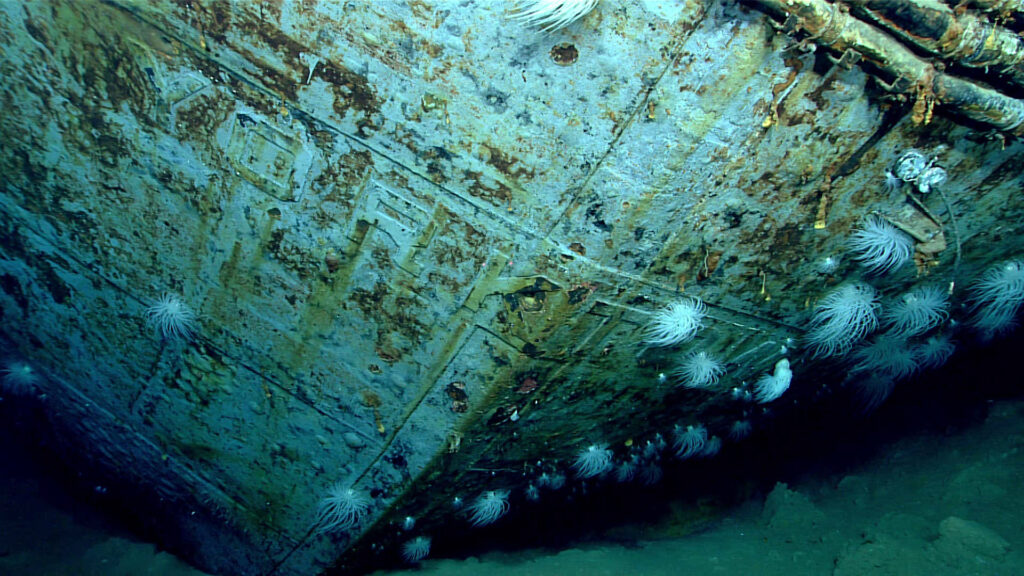
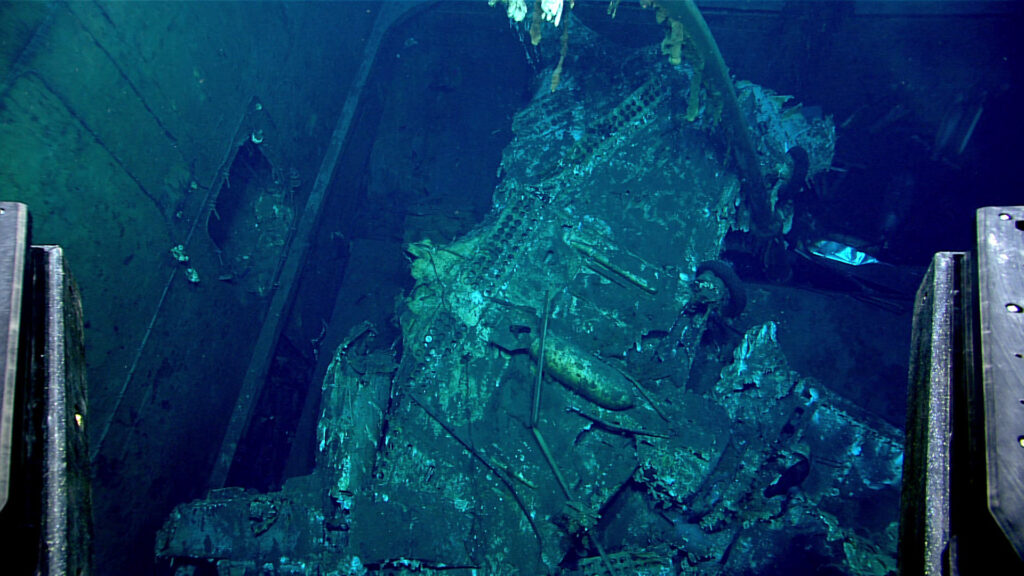
At more than three miles down, the Yorktown exists in a place almost beyond human imagination. There is no natural light. No warm currents. Only darkness, broken by the occasional glow of deep-sea organisms and the lights of robotic explorers. The ship rests like a ghost of history, its metal frame slowly aging in the cold water. Yet the deep sea also preserves. Without waves, storms, and human interference, some parts of the wreck remain remarkably intact, protected by the stillness of the abyss.
The USS Yorktown is more than a sunken vessel—it is a memorial. It represents the courage of those who served aboard it, the pilots who launched into danger, and the crew who fought to keep it alive. It reminds us that victory in war is never free. It is purchased with effort, sacrifice, and lives forever changed. Yorktown’s resting place is not just an underwater grave, but a monument to a defining moment in history.
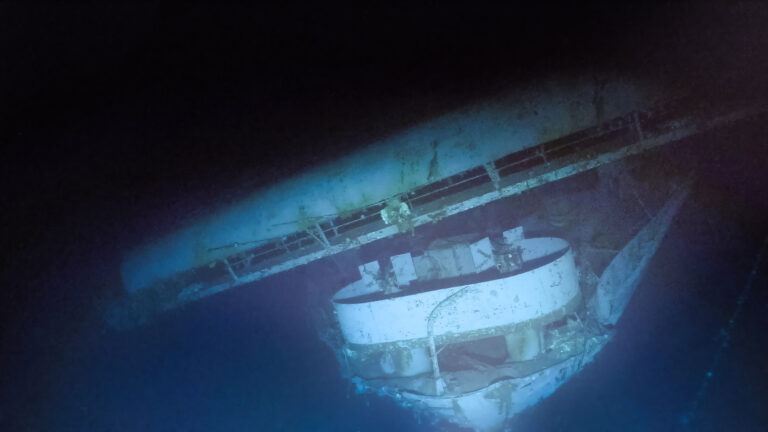
Even now, as it lies in eternal darkness beneath the Pacific, the USS Yorktown continues to speak—without words. It speaks through its silence, through its broken steel, and through the weight of the story it carries. Far above it, the ocean surface reflects the sun, ships pass by, and the world moves forward. But deep below, in a place where time feels paused, Yorktown remains exactly where it fell—an American legend resting in the cold embrace of the deep.