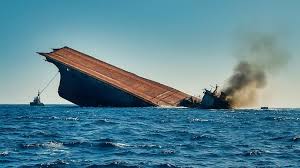
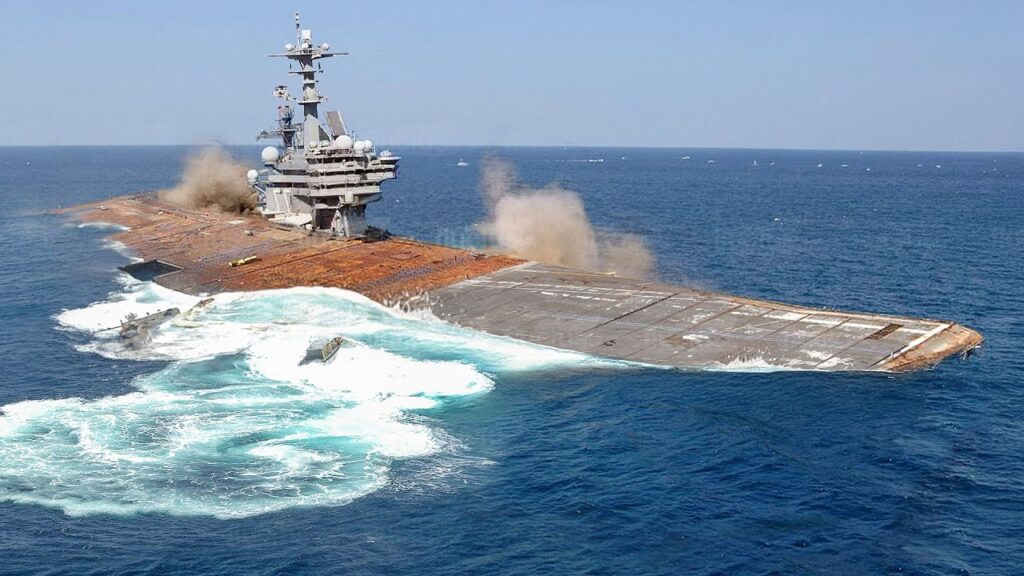
The final moments of USS America (CV-66) in 2005 were not simply the end of a ship—they were the closing chapter of an era. Beneath the vast sky and over the restless surface of the Atlantic, the once-mighty aircraft carrier slipped into history in a way few warships ever do: not retired peacefully into a museum, not scrapped in pieces at a shipyard, but deliberately sent to the ocean floor. Her sinking was controlled, intentional, and symbolic, yet it carried a quiet emotional weight that was impossible to ignore. USS America had been more than steel and machinery. She was a floating city, a weapon of national power, and a home to thousands who served aboard her across decades of Cold War tension and global change.
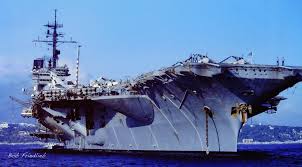
Commissioned in 1965, USS America entered service at a time when the United States Navy was rapidly modernizing and expanding its reach. The world was divided between superpowers, and aircraft carriers stood at the center of American naval strategy. They were mobile airfields capable of projecting force anywhere on Earth. The arrival of USS America strengthened that strategy, adding another massive, capable platform to the fleet—one that would go on to serve for 31 years. Over those decades, she became a familiar presence in the Atlantic and Mediterranean, a guardian of sea lanes, a symbol of deterrence, and a reminder that American power could arrive swiftly and decisively.
During her years of service, USS America operated through periods of intense geopolitical uncertainty. The Cold War shaped nearly every deployment, every exercise, and every mission. Carrier strike groups like hers were often positioned not just for combat, but for influence—standing watch near hotspots, reassuring allies, and warning adversaries. While much of her work took place beyond the public eye, her importance was deeply understood by those who served aboard her. Life on a carrier was demanding and relentless. The ship never truly slept. Flight operations could run day and night, with the roar of jets echoing across the deck and through the hull. Below deck, crews maintained engines, weapons systems, radar, and navigation, ensuring the ship remained ready at all times.
For sailors and aviators, USS America was both workplace and world. She carried thousands of personnel at a time—each one with a role that mattered. From pilots launching into the sky to deck crews guiding aircraft with hand signals, from cooks feeding the crew to mechanics repairing complex systems, the carrier depended on coordination and discipline. The ship’s strength was not only her size, but her people. Over three decades, countless individuals called her home, even if only for a deployment. Many remembered the feeling of stepping onto the flight deck under open sky, the smell of fuel and salt air, and the overwhelming sense of scale that only a supercarrier could provide.
By the time USS America was decommissioned in 1996, the world had changed. The Soviet Union had collapsed, and the Cold War had ended. New technology, new threats, and new priorities reshaped the Navy. Although USS America had served with distinction, she was no longer the most modern carrier in the fleet. More advanced ships had taken her place, and the cost of upgrading and maintaining older vessels continued to rise. Decommissioning marked the end of her active life, but not the end of her story. Many assumed she might become a museum ship, preserved like other famous carriers. Yet that future never came. Instead, USS America was chosen for a very different purpose—one that would ultimately lead to her dramatic end beneath the waves.
In 2005, the U.S. Navy decided to use USS America as a target ship in a sinking exercise. This decision was both practical and controversial. On one hand, sinking an old carrier provided a rare and valuable opportunity for research and training. The Navy could study how such a massive warship would respond to modern weapons and explosions. The lessons learned could help improve the design and survivability of future ships. Understanding the structural weaknesses of a carrier, how compartments flooded, how fires spread, and how the hull reacted under stress could save lives in the future. A ship of her size offered data no smaller vessel could provide.
On the other hand, the choice carried emotional weight. USS America was not just any ship. She was a symbol of American naval history, and many believed she deserved preservation. Unlike smaller ships, carriers are extremely expensive to maintain as museums, requiring massive funding, staffing, and infrastructure. Still, to some veterans and historians, sinking her felt like losing a piece of heritage. Yet the Navy moved forward, and USS America was prepared for her final mission—one that would not involve aircraft launches or battle readiness, but controlled destruction.
As the exercise began, the carrier faced a series of explosions and tests designed to simulate combat damage. The exact details of the testing were not fully public, adding an element of mystery to her final days. What is known is that the process took time. USS America did not sink immediately. She resisted. Her design, built for survivability and war, proved incredibly tough. Even after repeated blasts and damage, the ship remained afloat longer than many expected. This endurance became, in a strange way, her final demonstration of strength—proof that the engineers who built her had created something formidable.
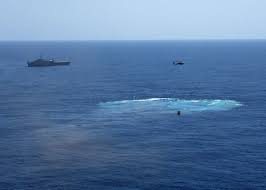
Eventually, though, the ocean claimed her. The final moments of USS America were likely hauntingly quiet. No crew stood on deck. No jets roared overhead. No flags flew in the wind. She sank alone, surrounded only by sea and sky, slipping beneath the surface as water filled her interior spaces. The ship that once carried thousands, that once moved with purpose across the globe, descended into darkness. The waves closed over her, and she disappeared from view, leaving behind only the rippling surface of the Atlantic.
There is something deeply poetic in that ending. USS America spent her life mastering the sea—commanding it, crossing it, and using it as a platform for power. In the end, she became part of it. Her sinking was not a defeat, but a transformation from weapon to wreck, from active service to silent monument beneath the waves. Now she rests on the ocean floor, unseen by most of the world, but remembered by those who served aboard her and by those who understand what she represented.
The legacy of USS America (CV-66) is not defined only by how she ended, but by how she lived. Commissioned in 1965 and active for 31 years, she carried generations of sailors through the challenges of the late twentieth century. She stood as a moving fortress during tense standoffs and uncertain times. She trained crews, supported missions, and strengthened alliances. And even in her final role, she served once more—helping the Navy learn, adapt, and prepare for future threats.
The final moments of USS America as she sank in 2005 were a farewell unlike any other. She did not fade quietly into rust at a dock. She did not become a tourist attraction. Instead, she completed her last assignment with the same toughness she had shown throughout her career. Beneath the waves, the ship that once carried the name America became a silent reminder of service, sacrifice, and the unstoppable passage of time.