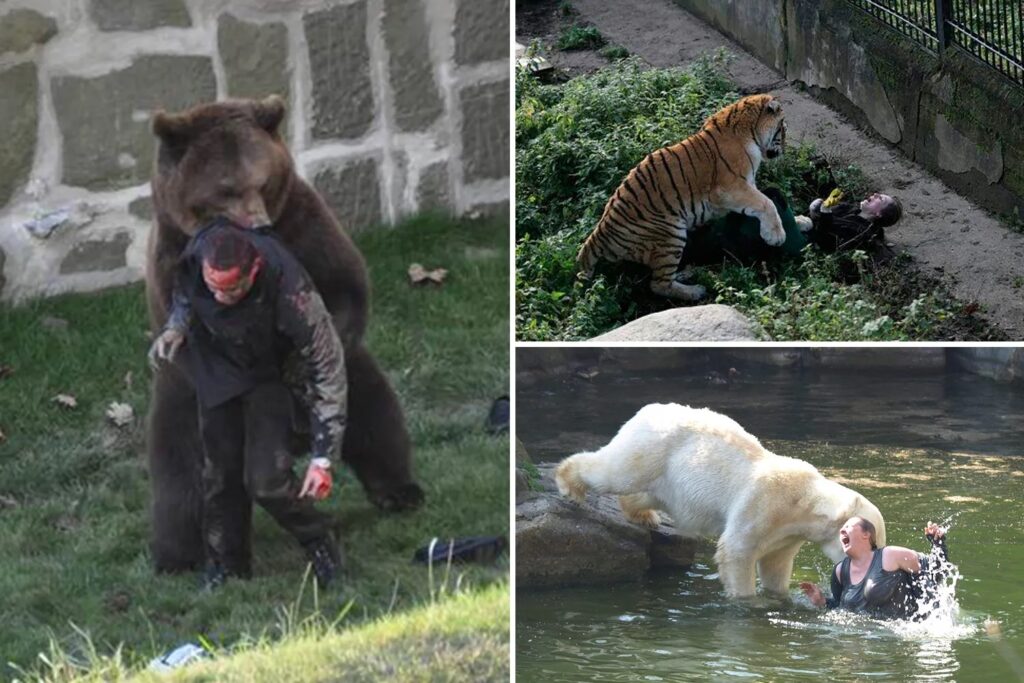
Zoos are designed to be places of wonder—where families gather to admire the beauty and power of wildlife from what seems like a safe distance. Yet beneath the carefully constructed habitats and reinforced glass lies an undeniable truth: wild animals remain wild. No matter how long they live in captivity, their instincts do not disappear. Throughout history, there have been tragic moments when barriers failed, rules were ignored, or unpredictable behavior led to deadly consequences.
These incidents are rare compared to the millions of safe zoo visits each year, but when they occur, they are shocking reminders of nature’s raw power.
The 2007 Tiger Attack at San Francisco Zoo
On Christmas Day in 2007, tragedy unfolded at the San Francisco Zoo. A Siberian tiger named Tatiana escaped her enclosure and attacked three young men. One of them, 17-year-old Carlos Sousa Jr., was killed. Two others were seriously injured before police shot and killed the tiger.
Investigations later revealed that the tiger’s enclosure moat wall was lower than recommended standards for such a powerful animal. It was believed that the youths may have taunted the animal before the attack, though that did not lessen the devastating outcome. The incident sparked nationwide debate about zoo safety standards, enclosure design, and visitor behavior.
The 1975 Lion Attack at Lion Country Safari
In 1975, a young man entered the lion enclosure at Lion Country Safari in Florida. Ignoring strict safety rules, he left his vehicle in a drive-through safari park where visitors were required to remain inside their cars at all times. The lions quickly attacked, and he was fatally mauled before staff could intervene.
Drive-through safari parks offer a more immersive experience, but they rely heavily on visitor compliance. This tragedy reinforced the importance of strict enforcement and highlighted the thin line between fascination and fatal risk.
The 1999 Elephant Incident at Honolulu Zoo
In 1999, an elephant handler at the Honolulu Zoo was killed by an Asian elephant during routine care procedures. While elephants are often perceived as gentle giants, they are immensely strong and can react unpredictably—especially in captivity where stress and confinement may affect behavior.
The incident led to renewed scrutiny of elephant management in zoos across the United States. Critics argued that large, intelligent animals such as elephants require expansive spaces and complex environments that are difficult to replicate in captivity.
The 2012 Tiger Attack at Copenhagen Zoo
In 2012, a 20-year-old man climbed into the tiger enclosure at Copenhagen Zoo. Witnesses reported that he appeared intoxicated and intentionally entered the restricted area. He was fatally attacked by a Siberian tiger before zookeepers could respond.
Authorities confirmed there were no enclosure failures; instead, the tragedy resulted from deliberate rule-breaking. The event reignited conversations about personal responsibility and the unpredictable consequences of entering wild animal habitats.
The 2016 Gorilla Shooting at Cincinnati Zoo and Botanical Garden
Although not a fatal attack against a human, the 2016 incident at the Cincinnati Zoo became one of the most widely discussed zoo tragedies in modern history. A three-year-old child fell into the gorilla enclosure, and a 17-year-old western lowland gorilla named Harambe grabbed the boy.
Fearing for the child’s life, zoo officials made the controversial decision to shoot and kill the gorilla. The child survived, but the event sparked global debate about zoo design, parental supervision, and the ethics of keeping large primates in captivity.
The emotional intensity of this case demonstrated how quickly a zoo visit can turn into a life-or-death situation.
Why Do These Attacks Happen?
Deadly zoo incidents typically fall into a few categories:
Human Error or Rule Violations – Visitors climbing barriers, entering restricted areas, or taunting animals. Enclosure Failures – Inadequate design or maintenance allowing animals to escape. Keeper Accidents – Close-contact procedures that carry inherent risks. Animal Stress and Instinct – Even well-trained animals can react unpredictably.
Wild animals operate on instinct. Predators such as lions and tigers are hardwired to respond to movement and perceived threats. Large mammals like elephants and gorillas possess immense strength that can become dangerous in seconds.
How Zoos Have Changed
Modern zoos have dramatically improved safety standards since many of these incidents occurred. Today’s facilities often feature:
Double-barrier systems Taller and reinforced enclosure walls Behavioral enrichment programs Strict no-contact policies Advanced surveillance systems
Additionally, accreditation organizations such as the Association of Zoos and Aquariums (AZA) enforce rigorous safety guidelines.
Yet no system is completely foolproof. Human curiosity, negligence, or overconfidence can undermine even the strongest safeguards.
A Delicate Balance Between Education and Risk
Zoos play a major role in wildlife conservation, breeding endangered species, and educating the public. For many people, a zoo visit is their first and only chance to see animals like tigers, elephants, or gorillas up close. That connection can inspire conservation efforts and environmental awareness.
However, these tragic events serve as sobering reminders that these creatures are not domesticated pets. They are apex predators and powerful wild beings whose instincts cannot be erased.
When animals bite back, it is rarely out of malice. It is instinct, triggered in an artificial environment.
Final Reflection
The deadliest zoo attacks in history are heartbreaking chapters in the story of human interaction with wildlife. They underscore the importance of respect—for the animals, for safety rules, and for the limits of human control.
Zoos continue to evolve, prioritizing both conservation and security. But the central lesson remains unchanged: no matter how high the glass walls rise or how carefully habitats are designed, the wild is never fully tamed.
And sometimes, when that boundary is crossed, the consequences are irreversible.