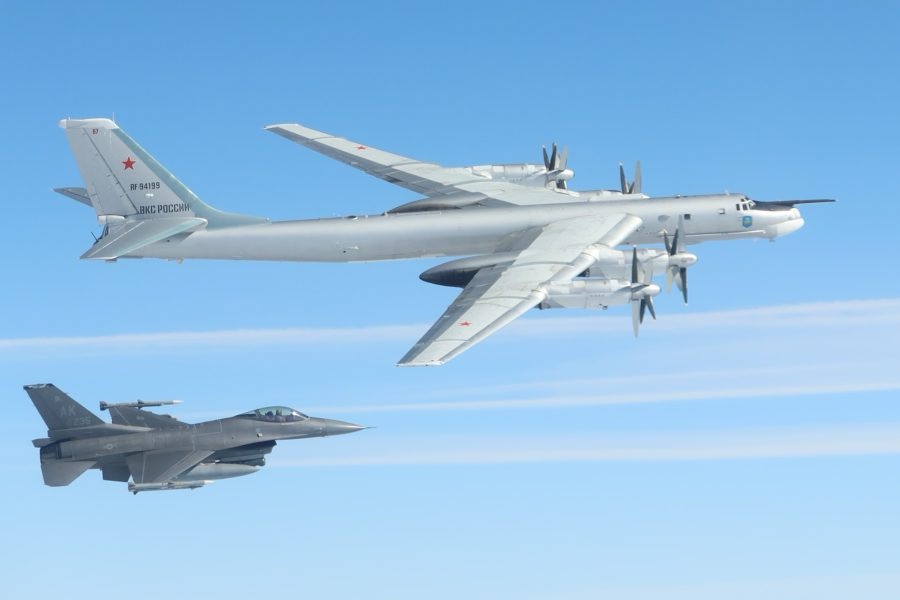
The North American Aerospace Defense Command (NORAD) detected, tracked and intercepted two Russian Tu-95s bomber planes, two Su-35s fighter planes and one A-50 spy plane until they departed the Alaskan ADIZ, officials said in a statementreleased late Thursday. The defense agency launched two F-16s, two F-35s and four KC-135s to complete the mission.
An ADIZ refers to a “stretch of international airspace” between the end of sovereign airspaces — in this case, that of Canada and the U.S. — “that requires the ready identification off all aircraft in the interest of national security,” according to NORAD
The military noted that the six Russian planes remained in the ADIZ and did not enter Canadian or U.S. airspace.
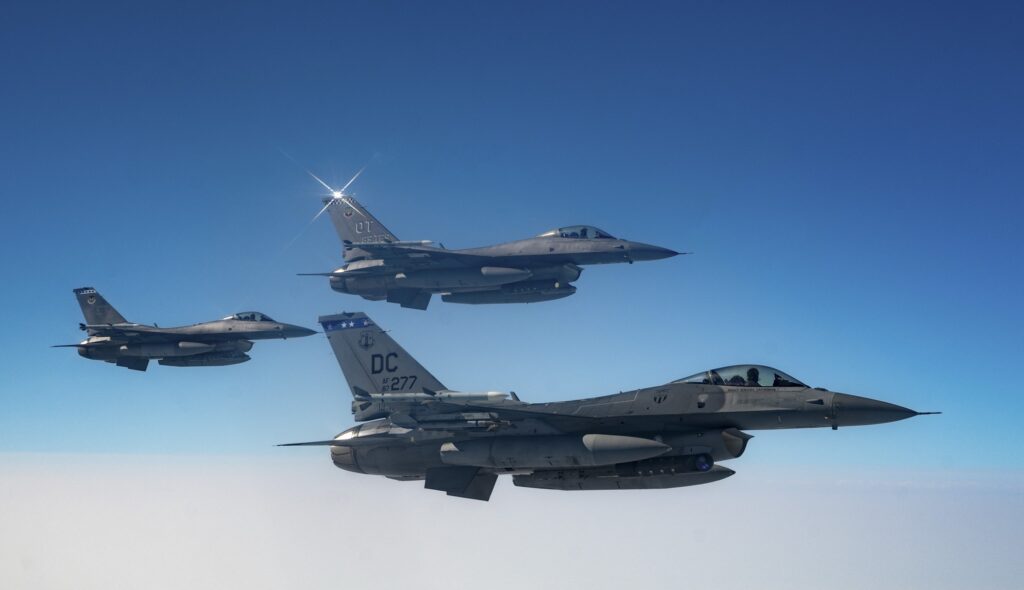
“This Russian activity in the Alaskan ADIZ occurs regularly and is not seen as a threat,” the statement reads.
Last September, NORAD said it detectedand tracked four Russian aircraft in the Alaskan ADIZ before successfully launching military aircraft to ward off the planes. The agency put out four similar notices about Russian aircraft off the coast of Alaska within the span of six days last August.
NORAD was created in 1957 following World War II as a shared operational command organization between Canada and the U.S. to protect each country’s airspace. The agency’s commander — currently U.S. Air Force Gen. Gregory M. Guillot — is jointly appointed by the U.S. president and the Canadian prime minister.
The command is charged with detecting and warning of attack from “aircraft, missiles, or space vehicles,” according to the organization’s website