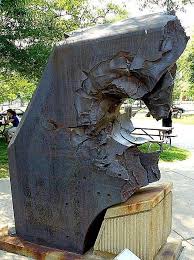
In the halls of the U.S. Navy Museum in Washington, D.C., visitors can find a striking reminder of how overwhelming naval firepower became during the Second World War. One exhibit in particular stops people in their tracks: a massive section of armor plate taken from a Japanese Yamato-class battleship, a ship once considered nearly unstoppable due to its extraordinary protection. The armor is more than 26 inches thick, a staggering wall of steel designed to withstand the heaviest shells ever fired at sea. Yet, despite its immense strength and engineering, this armor was pierced by a single weapon that represented the peak of American battleship technology: the 16-inch U.S. Navy Mark 7 naval gun.
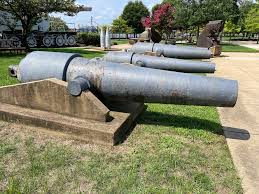
The Yamato-class battleships—most famously Yamato and Musashi—were built with one purpose in mind: to dominate the oceans through sheer size, armor, and firepower. Japan designed them as floating fortresses, capable of surviving punishment that would destroy ordinary warships. Their armor protection was legendary, and their main guns were the largest ever mounted on a battleship. Everything about them reflected a belief that the decisive naval battle would come down to battleships trading massive shells at long range. In that kind of duel, armor mattered as much as accuracy.
To protect vital parts of the ship—such as ammunition magazines, engine rooms, and command spaces—the Yamato-class relied on thick belt armor and heavy deck protection. This wasn’t just a thin layer of steel meant to resist smaller weapons; it was an engineered barrier intended to stop armor-piercing shells traveling at extreme speeds. Over 26 inches of armor represents the kind of defensive design that seems almost impossible to overcome. For perspective, that thickness is comparable to the height of a small child, but made entirely of hardened battleship-grade steel.
So how could it be pierced?
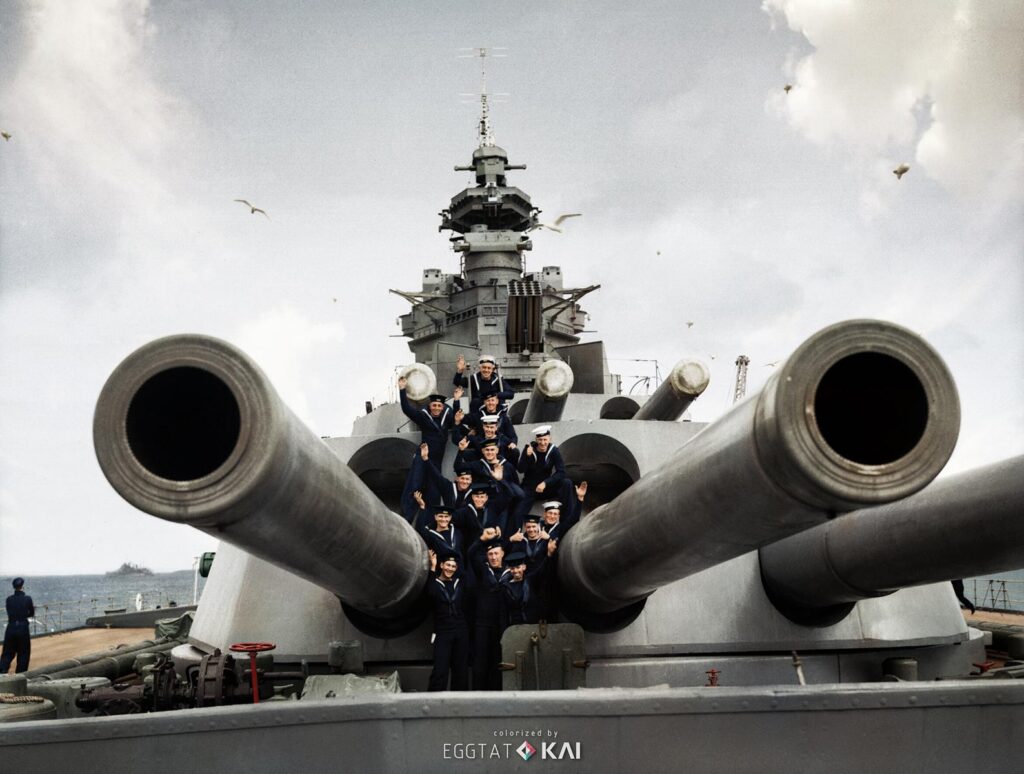
The answer lies in the relentless development of naval artillery and ammunition during the war. The United States Navy’s Mark 7 16-inch gun, mounted on the Iowa-class battleships such as the USS Iowa, USS New Jersey, USS Missouri, and USS Wisconsin, was one of the most powerful and advanced naval weapons ever created. While Japan’s Yamato-class carried larger guns, the U.S. focused on a combination of accuracy, rate of fire, advanced fire-control systems, and highly effective armor-piercing shells. The Mark 7 was not just about size—it was about performance.
A 16-inch gun may sound like a simple measurement, but it represents an enormous scale of destructive power. The shells fired by these guns weighed as much as a small car, and when launched, they traveled at tremendous velocity. Their kinetic energy alone was devastating, but when combined with specialized armor-piercing design, they became capable of punching through thick steel plating before detonating inside the ship. This was the nightmare scenario for any battleship crew: a shell that didn’t explode on the surface, but instead burrowed deep into the vessel and detonated where it could cause catastrophic damage.
The armor plate displayed in the museum tells that story without needing words. It stands as physical evidence that even the greatest defensive measures could be defeated. The impact and penetration mark demonstrate not only raw power, but also the scientific precision behind naval warfare. Battleships were not simply brute-force machines—they were products of metallurgy, physics, engineering, and tactical planning. Every advantage, whether in shell design or gun performance, could mean the difference between survival and destruction.
For many people, the Yamato-class battleships symbolize the “ultimate battleship,” the final evolution of a concept that had dominated naval strategy for decades. But this exhibit also reflects the shifting reality of warfare during World War II. While battleships remained awe-inspiring, the war increasingly proved that air power, submarines, and coordinated fleet tactics could overcome even the most heavily armored giants. The idea that a ship could be made “invincible” through armor alone was fading fast.
Still, the fact that the Mark 7 could pierce such armor remains remarkable. It shows how naval guns had reached a terrifying peak—capable of smashing through defenses once thought unbreakable. The moment a shell penetrated that armor plate, it proved a hard truth: no matter how thick the steel, there was always a bigger gun, a faster shell, or a more effective method of attack waiting to challenge it.
The museum display in Washington, D.C. is more than a piece of steel. It is a fragment of history, connecting visitors to an era when warships were measured not only by their length or tonnage, but by the thickness of their armor and the caliber of their guns. It reminds us that battleships were once the kings of the sea, and that nations poured immense resources into making them stronger, tougher, and deadlier than anything before.
But it also represents the limits of power. The Yamato-class was built to withstand almost anything, yet it existed in a time when technology was advancing too quickly for even the most ambitious designs to remain untouchable. The ability of the U.S. Navy’s 16-inch Mark 7 gun to pierce more than 26 inches of Japanese battleship armor stands as a dramatic example of that reality.
Today, standing in front of this armor plate, one can’t help but feel the weight of what it represents—both literally and historically. It is the weight of industrial might, of wartime urgency, and of the men who served aboard these colossal ships. It is a reminder that behind every piece of military technology are real human lives, real decisions, and real consequences.
In the end, this pierced armor is not only a symbol of American firepower or Japanese engineering. It is a symbol of a turning point in naval warfare, when even the strongest steel could be defeated, and when the era of the battleship—once the ultimate weapon of the sea—began to give way to new forms of dominance in the modern world.