Quick reality check though: the Yak-141 was a Soviet prototype that never entered full operational service. So this works best as a fictional military scenario.
Here’s a full 1000-word story version with a stronger, cinematic new title:
New Title:
“Inferno in Open Waters: The Night the Ammunition Ship Vanished”
Inferno in Open Waters
Thirteen minutes ago, the Atlantic was calm.
The American cargo vessel Liberty Dawn moved steadily across dark waters under a moonless sky. Her hull carried 9,500 tons of ammunition—precision-guided munitions, artillery shells, naval ordnance—destined for allied stockpiles overseas. She wasn’t a warship. She carried no heavy missile batteries, no advanced radar arrays like those mounted on front-line destroyers. She was logistics—quiet, essential, vulnerable.
At 02:14 GMT, a radar operator noticed a faint anomaly at extreme range.
“Probably civilian traffic,” someone muttered.
But the contact was wrong. Too fast. Too low.
The object skimmed the ocean surface, vanishing in sea clutter, then reappearing closer. Its flight path was aggressive—deliberate. Within seconds, the cargo ship’s defensive alert system triggered a warning tone.
Unidentified fast-mover. Bearing 087.
The silhouette appeared on infrared moments later—a delta-wing aircraft with downward-canted stabilizers. Analysts would later identify it as a modernized variant of the Yak-141, a vertical takeoff fighter once abandoned decades ago. In this alternate reality, it had been resurrected and upgraded—new avionics, advanced targeting pods, long-range anti-ship capability.
The pilot had one mission.
Neutralize the cargo.
At 02:16 GMT, the first missile separated from the fighter’s wing.
The launch was silent from the ship’s perspective. No dramatic warning. Just a spike on the sensor screen—and then impact.
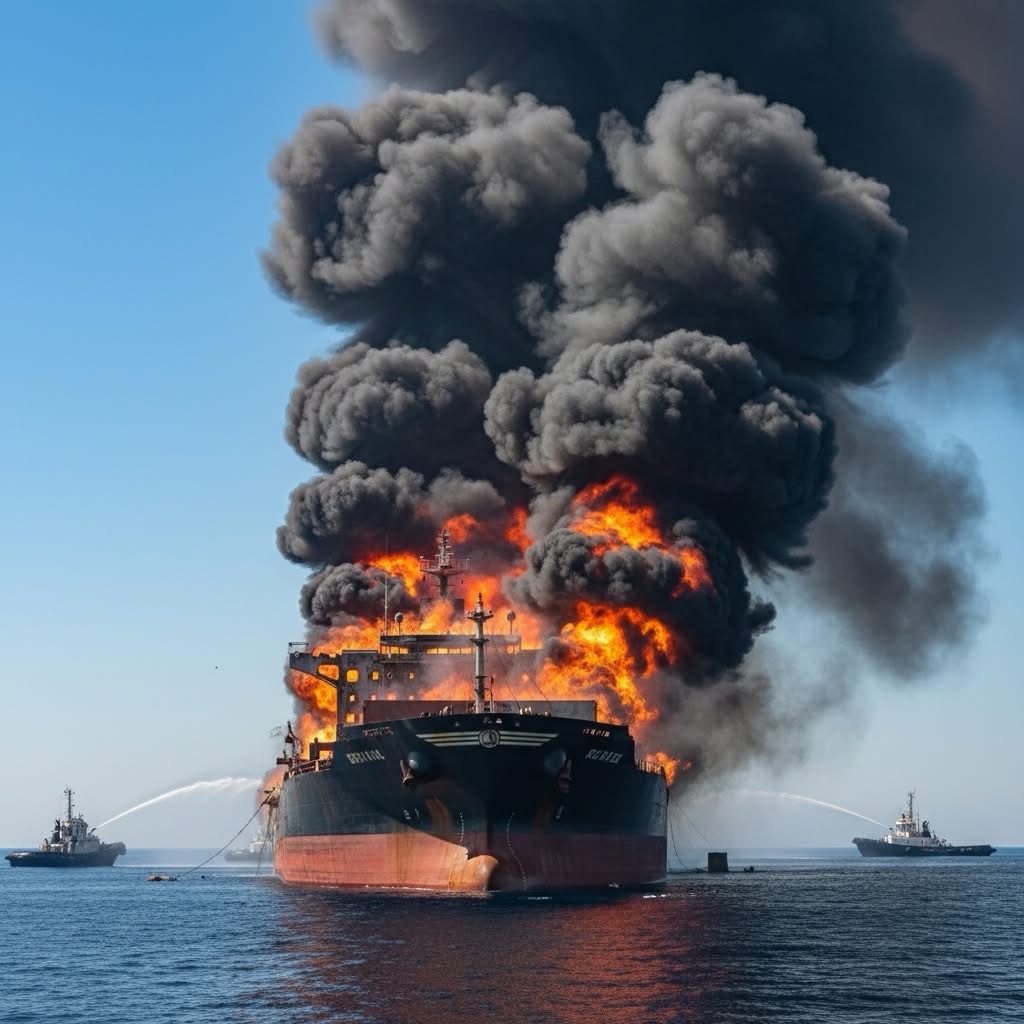
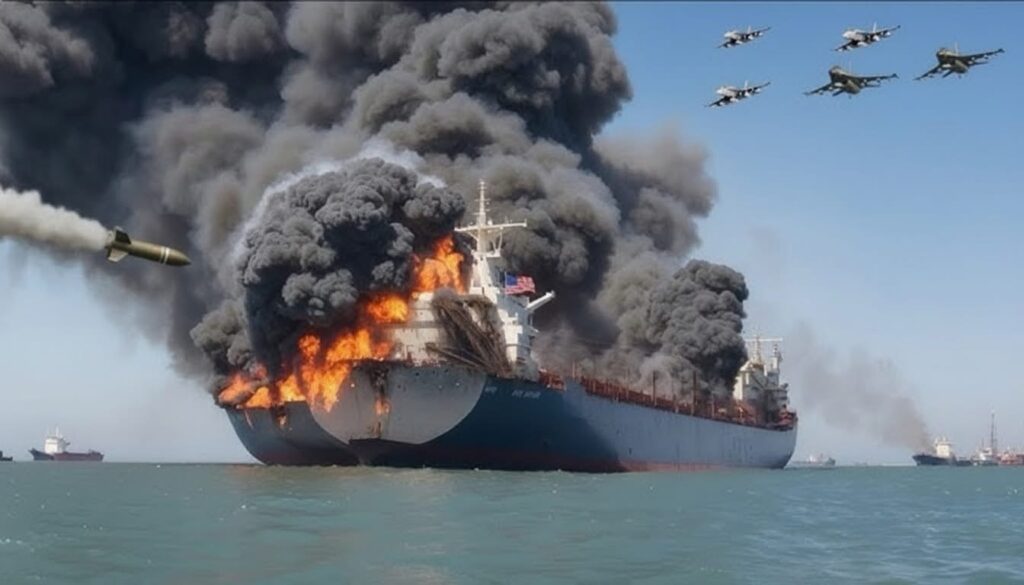
The missile struck the aft section, punching through the superstructure before detonating internally. The explosion tore open compartments and ignited secondary fires. Crew members were thrown off their feet as alarms wailed through smoke-filled corridors.
Damage control teams scrambled.
“Fire in compartment 4B!”
“Seal the hatch!”
The ship listed slightly but maintained propulsion. For a moment, it seemed survivable.
Then the second missile came.
This one aimed lower—closer to the ammunition holds.
The detonation was catastrophic.
A blinding fireball erupted from the midsection, sending a column of flame hundreds of feet into the night sky. The blast wave rippled across the ocean surface like a shock ring. Containers were hurled into the air. Metal twisted as though made of paper.
Onboard cameras cut to static.
Nearby commercial vessels, miles away, saw the glow crest the horizon.
Within minutes, distress signals flooded maritime emergency channels. NATO monitoring stations picked up fragmented transmissions before they went silent.
The Liberty Dawn was burning from within.
Crew members fought to deploy lifeboats as secondary explosions cracked through the hull. Ammunition cooking off created unpredictable blasts—sharp concussions that echoed across the sea.
Above, the Yak-141 circled once.
Thermal imaging confirmed mission success.
Then it disappeared into darkness.
Back on the cargo ship, the captain made the call no commanding officer wants to make.
“Abandon ship.”
Life rafts hit the water as flames engulfed the forward deck. The vessel’s bow began to dip. Steel groaned under impossible stress. Fire met explosives in a chain reaction that would later be compared to a floating arsenal detonating all at once.
At 02:27 GMT, a massive internal blast split the ship nearly in two.
The stern rose briefly, silhouetted against its own inferno—then slid beneath the Atlantic.
Silence followed.
Except for burning debris drifting across black water.
The Global Shockwave
Within fifteen minutes, military satellites had replayed the strike from orbit. Analysts confirmed the attacker’s profile. The political consequences were immediate.
Financial markets trembled at pre-market openings.
Emergency meetings were convened in Washington and Brussels.
Officials debated terminology carefully. “Act of war” carries weight. So does “escalation.”
In Moscow, officials denied involvement. Unconfirmed footage circulated online—grainy, distant, inconclusive.
Experts began asking dangerous questions:
How did a prototype platform re-emerge in operational form? Was the strike state-authorized—or rogue? Was this a warning shot?
Strategists pointed out the vulnerability exposed: logistics ships are lifelines. Without ammunition, fleets cannot fight. Destroying supply at sea shifts the balance without confronting heavily armed carriers or destroyers directly.
It was asymmetric.
Calculated.
Terrifyingly effective.
The Survivors
Rescue vessels arrived within the hour. Many crew members were pulled from rafts, shaken but alive. Some suffered burns and blast injuries. Others stared silently at the smoking horizon where their ship had vanished.
One sailor later described it simply:
“It was like the ocean exploded.”
The environmental impact would take weeks to assess. Thousands of tons of military-grade material now rested on the seabed.
Naval patrols intensified across the region.
Fighter squadrons were placed on high alert.
And somewhere, in a secured hangar far from public view, a vertical-takeoff jet cooled after its most consequential flight.
What Happens Next?
History shows that single strikes can reshape global stability.
Sometimes retaliation follows.
Sometimes restraint.
The destruction of a 9,500-ton ammunition ship is not just a tactical loss—it is symbolic. It demonstrates reach. Capability. Intent.
And intent is what worries leaders most.
Because thirteen minutes is all it took to turn calm water into a geopolitical flashpoint.
And in modern conflict, thirteen minutes is an eternity.