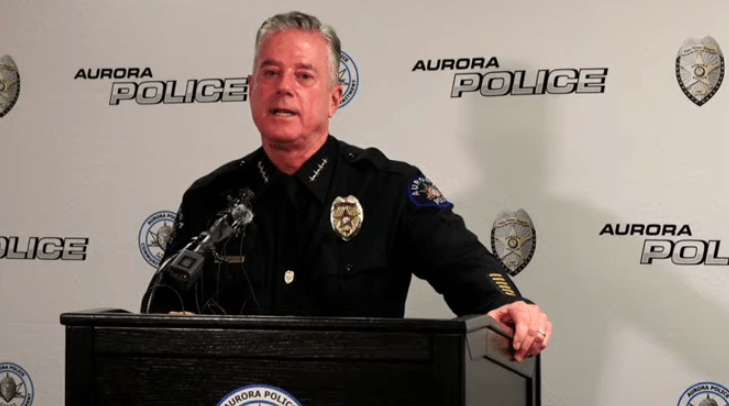
AURORA | In a community meeting Wednesday, Aurora Police Chief Todd Chamberlain made it clear that even with dialogue and reform, use of force will always be necessary for police because the outcomes are constrained by human behavior.
“I wish we could say that we could have conversations and fix everything; reform in law enforcement is nonstop,” Chamberlain said. “These are things that are continually evolving, and these are things that are based upon humans and human responses.”
Framed as “a help and healing session, not finger-pointing,” community leaders and Aurora Police held a two-hour community forum closed to the public to discuss the Aug. 30 officer-involved shooting of Rajon Belt-Stubblefieldand how the community can move forward with trust and prevent future tragedies.
“Silence breeds mistrust, and that is exactly why I reached out,” Chamberlain said. “That’s what I’m hoping to get out of this, and that’s what I hope you get out of this. I hope you get some clarity. I hope you get information that maybe you did not have before.”
“’ll be honest, you can’t,” he said. “There are going to be officer involved shootings. There are going to be use of force situations.”
He said there will always be people who don’t want to go to jail or be held accountable for victimizing other people
“There are people who will make bad decisions at the wrong time for the wrong reasons, and unfortunately, the people that have to stand there in front of those individuals are people wearing uniforms, and that is going to be the reality,” Chamberlain said.
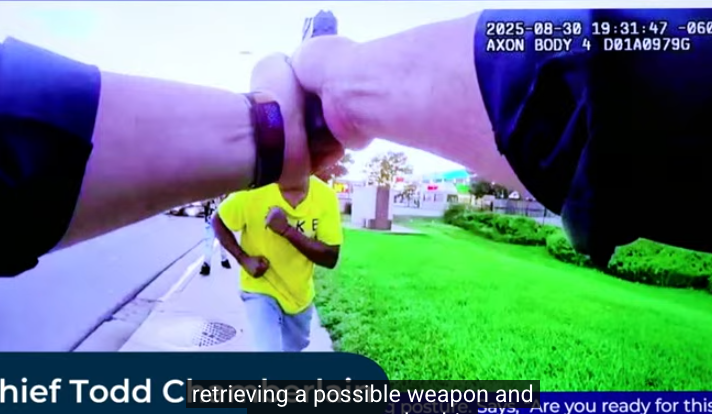
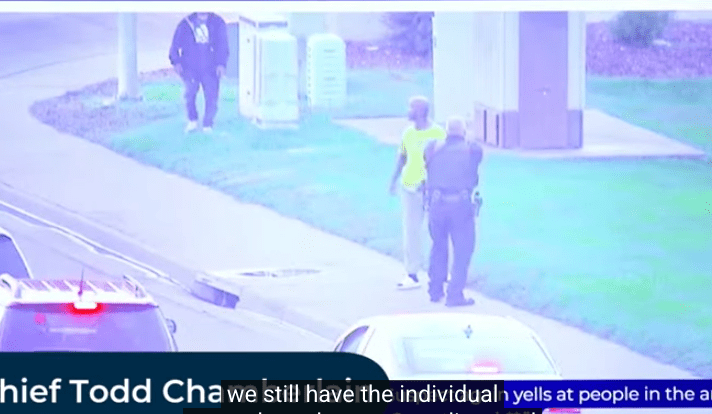
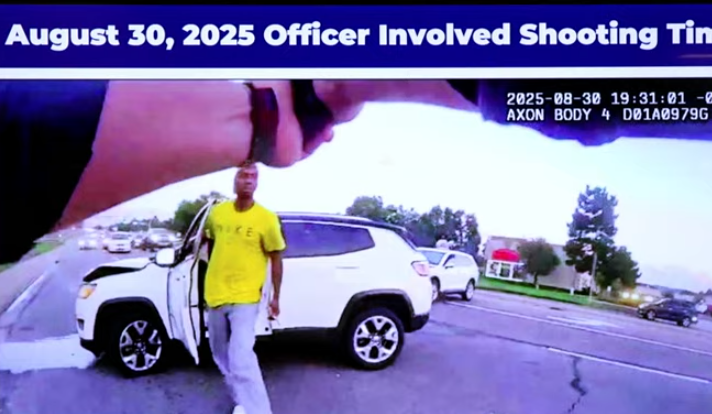
The meeting started with Chamberlain recounting the events of the shooting with what he said were preliminary facts from body-worn and dash-camera videos.
He said that the police shooting investigation is being handled by an outside team, led by the 18th Judicial District, with an APD administrative review to follow. He said that he would have released the body camera footage almost immediately, but the department had to wait until 72 hours after Belt-Stubblefield’s family viewed the footage, a procedure dictated by state law.
He said the the department plans to release the officer body cam video Friday at 1 p.m.
“This was without question a tragedy,” Chamberlain said, and he added that even though it wasn’t the outcome he would have liked, he did see the officer show clear signs of trying to de-escalate the confrontation by using verbal commands, time and distance.
He also said that two people were involved in the incident, Belt-Stubblefield and the officer, but people usually only focus on the officer’s actions.
Brewer told the community members he wanted to keep the conversation solution-oriented and then opened by quoting a few statistics from statista.com.
“Sadly, there is a trend of fatal police shootings in the United States that seems to only be increasing, with a total of 1,173 civilians having been shot, 248 of whom were Black, as of December 2024,” Brewer said. “In 2023, there were 1,164 fatal police shootings. Additionally, the rate of fatal police shootings among Black Americans was much higher than that of any other ethnicity, standing at 6.1 fatal shootings per million of the population per year between 2015 and 2024.”
BBChamberlain offered a counter argument to statistics like those and determinations by the Colorado attorney general that people of color are disproportionately abused by Aurora police during confrontations.
“We looked over a 10-year period, from 2015 to 2025, and I looked at all the officer-involved shootings,” Chamberlain said. “The highest number of individuals involved in these officer-involved shootings that are shot at by the officer are white.”
In those 10 years, Chamberlain said that 29 were white, 26 were Black, seven were Hispanic, and one was Asian. State and other officials say those numbers speak for themselves because of the proportion of people shot by police in proportion to their minority in the population. The most recent U.S. Census data shows that Black people make up about 15%-17% of the Aurora population. Statistics offered by Chamberlain reveals that Black people account for 46% of APD officer-involved shootings.
People at the roundtable were asked by Brewer to focus on finding a way to help APD and Aurora residents get to a point where an incident like the shooting of Belt-Stubblefield never happens again.
“When we get into these interactions in our community with police, one thing that we need to make sure is happening is that the interaction between the officer and the suspect, is respectful, is equitable, is not biased, it’s not based on prejudgment and there is a reasonable picture that is determined before certain responses are made,” Brewer said.
Aurora is currently under a 2021 state-imposed consent decree based on an investigation that found that Aurora police have for years exhibited “patterns and practices” of disproportionately using excessive force against Black people and people of color.
One community member, Eric Nelson, a former Aurora Public Schools board member, asked if the officer in the shooting was current in his training when dealing with someone who could have been under the influence. Nelson questioned the amount of time that could have been used for less lethal measures.
“No matter how you slice it, when you look at that video, there was time to use a taser, there was time to do other measures,” Nelson said.
APD has not released the name of the Aurora officer despite numerous media requests.
Referring to the video footage from the public and what Chamberlain saw from the body camera footage, he said that the officer tried multiple times to grab his baton and other tools on his belt for a less lethal option.
“In the video, he is trying to holster his weapon and transition by reaching across the front of his body toward less lethal tools,” Chamberlain said. “He could not do it.”
The officer was unable to grab those tools, Chamberlain said, because Belt-Stubblefield kept moving toward him.
Chamberlain said the officer did try to de-escalate the confrontation through verbalization, backing up, space, patience and then, ultimately, punching Belt-Stubblefield in the face with his fist.
“I know people have the idea and the thought process that de-escalation is a tool, that de-escalation is a philosophy,” Chamberlain said. “De-escalation is an idea of giving space, of giving time, of giving commands, of giving patience.”
He said it can also be a taser shock, a rubber bullet, mace or a baton.
“It wasn’t perfect de-escalation,” he said. “It didn’t have the results that we wanted, but there was de-escalation.”
Chamberlain said that officers are continually trained in mental health, de-escalation and dealing with individuals at a “heightened emotional level.” He later added that police have become a catch-all for mental health and various other issues they are not fully equipped for.
The city police department’s Crisis Response Team is limited, he said, and only covers specific kinds of incidents involving mental health. Chamberlain said the CRT would not have been used in Belt-Stubblefield’s case, nor would they be used for substance abuse issues or possibly even homeless situations.
“I’m going to be open on this,” Chamberlain said. “There are things that we could have done better, and things we are going to do better.”
Chamberlain said that the department is already making policy modifications.
“We are, without question, devoted to transforming our organization into the best organization in the United States of America, and the only way you can do that is through continuous improvement, training and evolving based upon the situations and circumstances that we’re confronted with,” Chamberlain said.
Chamberlain told Nelson that the officer involved in the Belt-Stubblefield shooting is an older, tenured officer who has been on the force for a considerable time. He also said he doesn’t think the officer is doing well, and that taking a life takes a toll on the officers, too.
“We’re not a family,” Chamberlain said about the police department. “This department is a business, and our business is providing a safe community for the city of Aurora, and so I use evaluation tools to verify that this business is effective, that we are meeting the standards, that we are meeting policies and procedures, that we are doing the right thing.”