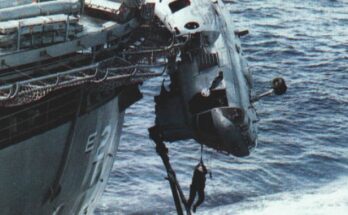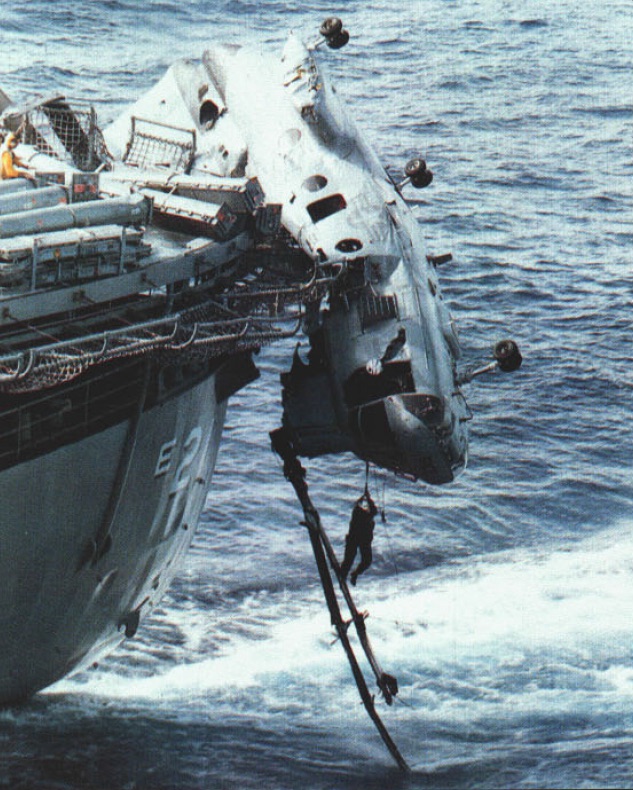
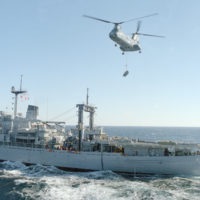
The UH-46D Sea Knight was a familiar and vital workhorse of the United States Navy, trusted for decades to move cargo, personnel, and supplies between ships at sea. With its distinctive tandem-rotor design and proven reliability, the helicopter played a critical role in replenishment operations, especially aboard ammunition ships such as USS Suribachi (AE-21). Yet even with experienced crews and well-established procedures, flight operations at sea remained inherently dangerous. One such danger became tragically evident during a crash involving a UH-46D Sea Knight on the stern deck of USS Suribachi.
USS Suribachi, a Kilauea-class ammunition ship, was designed to support carrier strike groups by delivering ordnance and supplies while underway. Operating helicopters was essential to this mission, allowing rapid vertical replenishment even when seas were rough. On the day of the incident, Suribachi was conducting routine operations, maintaining course and speed to support flight deck activity. Weather conditions were reportedly marginal, with moderate seas and shifting winds, creating a challenging environment for helicopter landings.
As the UH-46D Sea Knight approached the stern of the ship, the flight crew carefully coordinated with the deck crew below. Visual landing aids and radio communication guided the aircraft toward the designated landing spot. However, landing on a moving ship requires precise control, and even a slight miscalculation can quickly escalate into disaster. As the helicopter descended, witnesses noted an unstable approach, possibly caused by wind shear or turbulent air flowing over the ship’s superstructure.
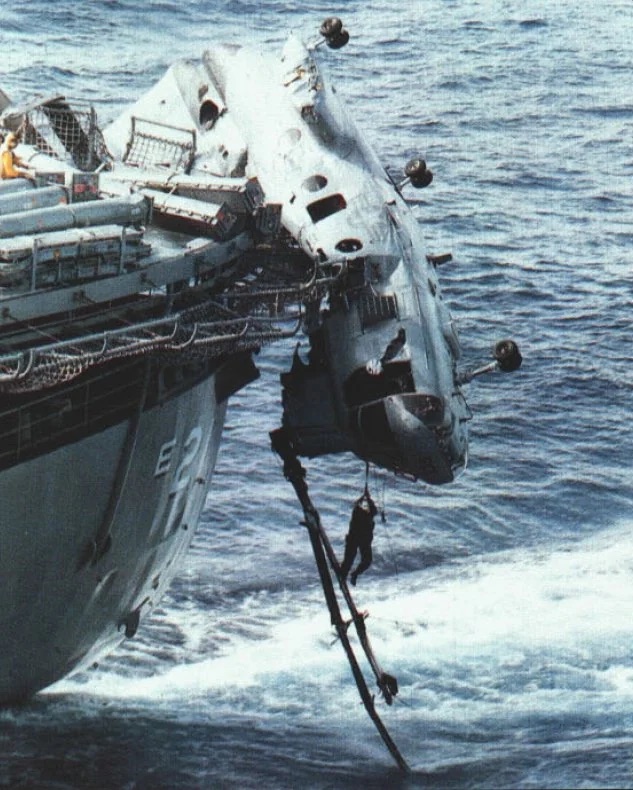
Moments before touchdown, the helicopter appeared to drift off centerline. The pilot attempted to correct, but the Sea Knight’s rear rotor struck part of the deck or nearby equipment on the stern. The impact caused a sudden loss of control, and the aircraft slammed hard onto the flight deck. The force of the crash damaged the landing gear and ruptured sections of the fuselage, while spinning rotors scattered debris across the stern area.
Deck crew members reacted immediately, rushing to secure the scene despite the dangers of spinning blades and leaking fuel. Firefighting teams were activated within seconds, spraying foam to prevent ignition as smoke rose from the damaged helicopter. The crew’s rapid response likely prevented the incident from becoming far worse, as ammunition ships like Suribachi carried highly sensitive and potentially catastrophic cargo.
The aircrew sustained injuries of varying severity, but thanks to swift medical response and adherence to emergency protocols, all personnel were evacuated and treated. The damaged UH-46D was later secured and eventually removed from service. While the helicopter was a total loss, the incident underscored the effectiveness of naval training and discipline in crisis situations.
An investigation followed, focusing on environmental conditions, mechanical performance, and human factors. Findings emphasized the extreme challenges of shipboard aviation, particularly on smaller or specialized vessels with limited deck space. Lessons learned from the crash were shared fleet-wide, leading to refinements in approach procedures, deck markings, and crew coordination.
The UH-46D Sea Knight would continue serving the Navy for many years, and USS Suribachi would return to duty after repairs and inspections. Though the crash was a sobering reminder of the risks faced by naval aviators and sailors alike, it also highlighted their professionalism and courage. In the unforgiving environment of the open sea, survival often depends on preparation, teamwork, and the ability to act decisively when seconds matter most.