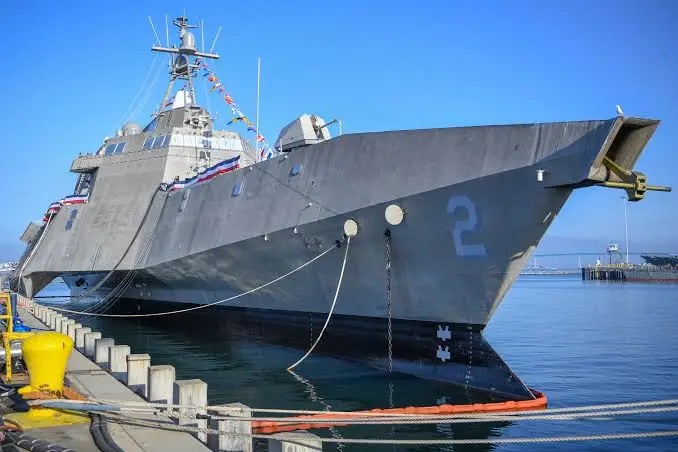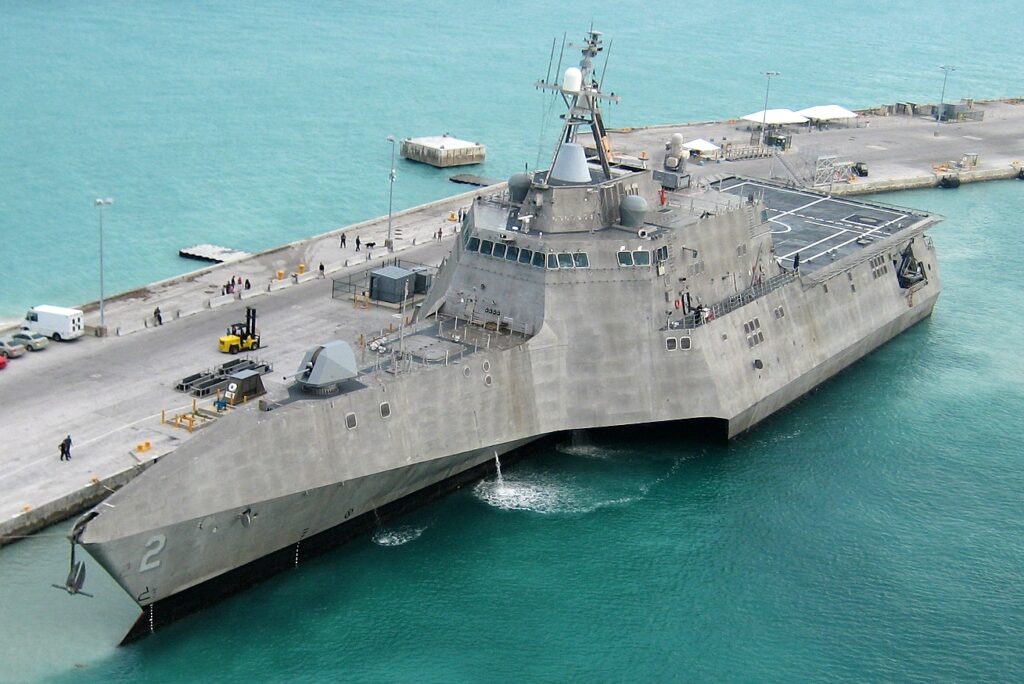
USS Independence (LCS-2) represents one of the most ambitious and unconventional warship designs ever introduced by the United States Navy. As the lead ship of the Independence-class Littoral Combat Ships, LCS-2 was built to redefine how the Navy operates in coastal and near-shore environments. With its distinctive trimaran hull, high speed, and modular mission concept, Independence became both a symbol of innovation and a focal point of debate within modern naval warfare.
Commissioned on January 16, 2010, USS Independence was constructed by Austal USA in Mobile, Alabama. Unlike traditional steel-hulled warships, the ship was built largely from aluminum, reducing weight and allowing for remarkable speed and agility. Its trimaran design—featuring a central hull flanked by two smaller outriggers—provided exceptional stability, a large flight deck, and expansive internal mission spaces. These characteristics made the ship visually striking and operationally unique among U.S. Navy vessels.
The Littoral Combat Ship program was born from the need to counter emerging threats in shallow waters, such as fast attack craft, diesel submarines, and naval mines. USS Independence was designed to operate close to shore where larger destroyers and cruisers might be restricted. Capable of exceeding 40 knots, the ship could rapidly deploy to hotspots and respond to evolving threats with unprecedented speed.
One of the defining features of USS Independence was its modular mission system. Instead of being permanently outfitted for a single role, the ship was intended to swap mission packages tailored for surface warfare, anti-submarine warfare, or mine countermeasures. This concept promised flexibility and cost efficiency, allowing a single hull to perform multiple missions over its service life. While the idea was revolutionary, implementing it proved far more complex than originally envisioned.
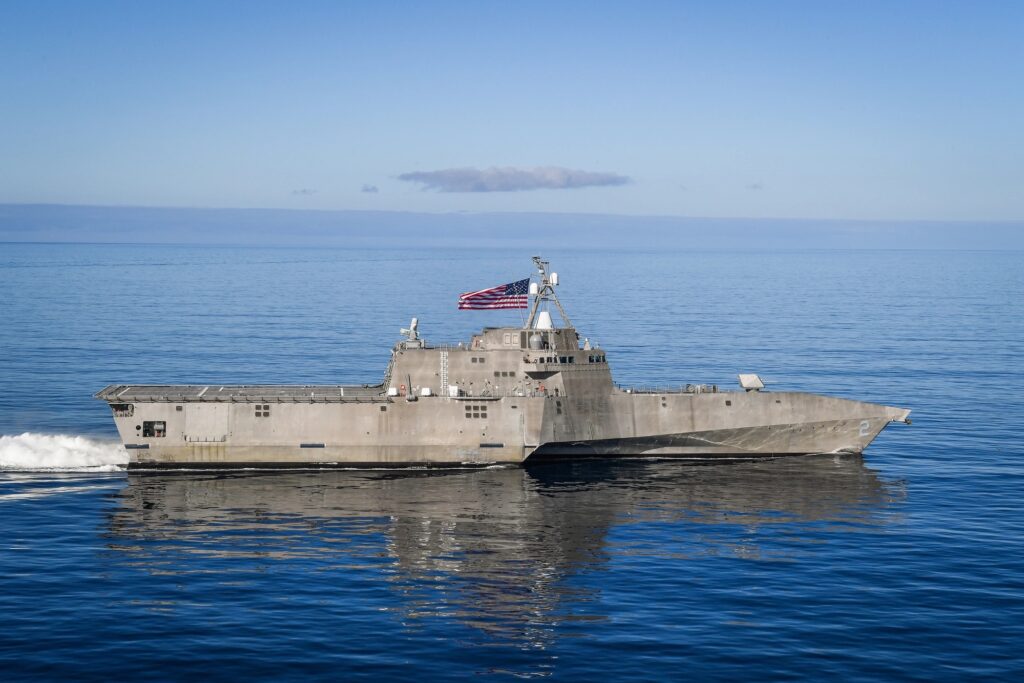
Operationally, USS Independence played a significant role in testing and refining the Littoral Combat Ship concept. The vessel conducted extensive sea trials, training exercises, and deployments aimed at evaluating new technologies, aviation integration, and crew structures. With a relatively small core crew compared to traditional warships, the ship relied heavily on automation and advanced systems to maintain operations.
Despite its innovative design, USS Independence also faced criticism and challenges. The LCS program, including LCS-2, was frequently scrutinized over cost overruns, survivability concerns, and mechanical reliability issues. Critics questioned whether the ship’s light armor and aluminum construction made it too vulnerable in high-intensity combat scenarios. Additionally, delays and technical difficulties with mission modules limited the ship’s ability to fully realize its original vision.
Even so, USS Independence contributed valuable lessons to the U.S. Navy. The ship demonstrated the advantages of large flight decks for helicopter and unmanned aerial vehicle operations, highlighting the growing importance of aviation and drones in modern naval warfare. Its shallow draft allowed access to ports and coastal regions unavailable to larger combatants, reinforcing the strategic value of smaller, faster warships.
As naval strategy evolved and priorities shifted toward great-power competition, the role of the Littoral Combat Ship was reassessed. USS Independence, like several early LCS vessels, was eventually slated for early decommissioning as the Navy moved toward more heavily armed and survivable platforms. While this decision sparked debate, it underscored the experimental nature of LCS-2 and its role as a testbed rather than a final solution.
The legacy of USS Independence lies not only in its service record but also in its influence on future ship design. The lessons learned from its trimaran hull, automation systems, and mission flexibility continue to inform newer classes of warships and unmanned surface vessels. In this way, Independence fulfilled a crucial role as a bridge between traditional naval doctrine and the future of maritime warfare.
Though its operational career was shorter than initially planned, USS Independence remains a landmark in U.S. naval history. It stands as a bold attempt to challenge convention, adapt to new threats, and push the boundaries of what a modern warship could be. Whether viewed as a success, a cautionary tale, or both, the story of USS Independence is ultimately one of innovation, experimentation, and evolution at sea.