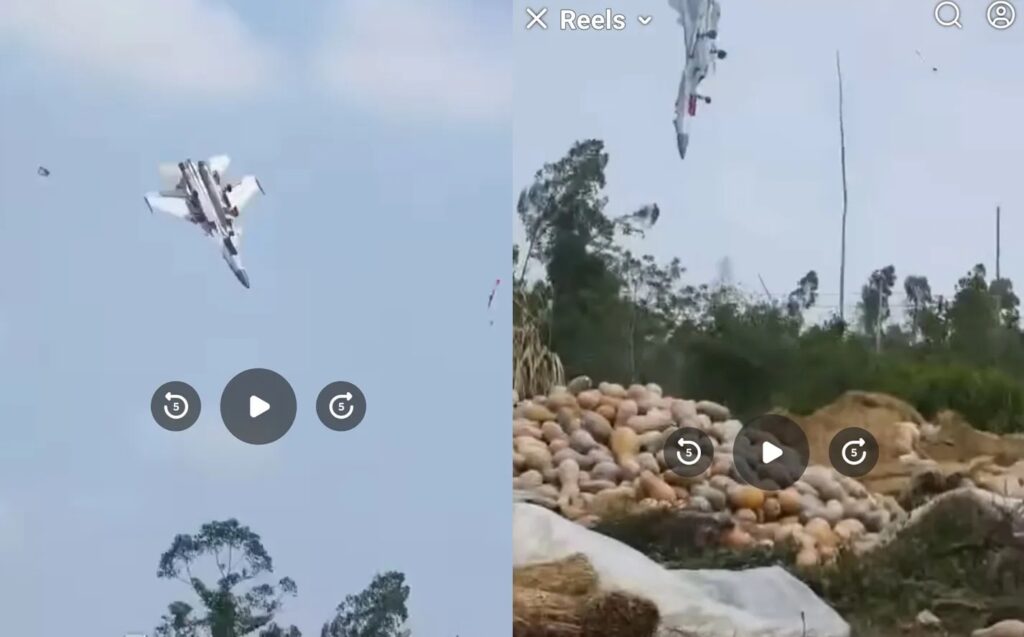
The crash of a Chinese Navy J-15 “Flying Shark” fighter jet on March 15 during a routine training exercise near Jialai Town in Lingao County, Hainan Province, has reignited scrutiny of China’s military aviation program.
While the pilot ejected safely and there were no reported casualties on the ground, the incident raises questions about the reliability of the aircraft and its components.
This latest crash is not an isolated event but a continuation of longstanding issues affecting China’s quest for self-reliance in military aviation.
Tracing J-15’s Troubles
The J-15, developed by Shenyang Aircraft Corporation, is a carrier-based multirole fighter that entered service in 2013. It was reverse-engineered from the Russian Su-33 after a prototype was acquired from Ukraine in 2001.
Touted as a cornerstone of China’s naval aviation capabilities, the aircraft was intended to project power in contested maritime areas like the South China Sea. However, its heavy airframe has consistently limited its payload and combat radius, diminishing its multirole effectiveness, especially in comparison to the U.S. Navy’s F/A-18 Super Hornet.
The J-15 also holds the unpleasant distinctionof being the heaviest carrier-based fighter in service. The J-15 weighs 38,000 pounds at empty weight, almost 6,000 pounds more than the F/A-18E/F Super Hornet and 4,000 pounds more than the F-35C.
Compounding these design limitations is the J-15’s reliance on the domestically produced WS-10 turbofan engine, a recurring weak point across China’s fleet
The WS-10, developed by the Aero Engine Corporation of China (AECC), was introduced to reduce reliance on Russian imports.
Initially envisioned as a breakthrough in indigenous aviation technology, the engine has been plagued by material deficiencies, quality control lapses, and insufficient testing. These challenges have not only affected the J-15 but also other aircraft in China’s fleet.