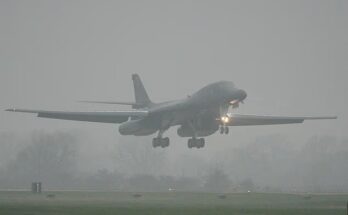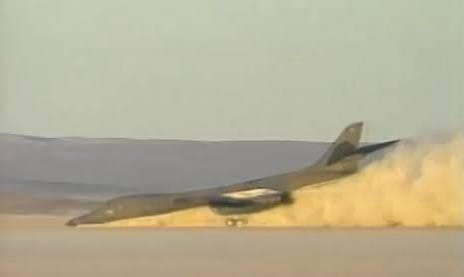
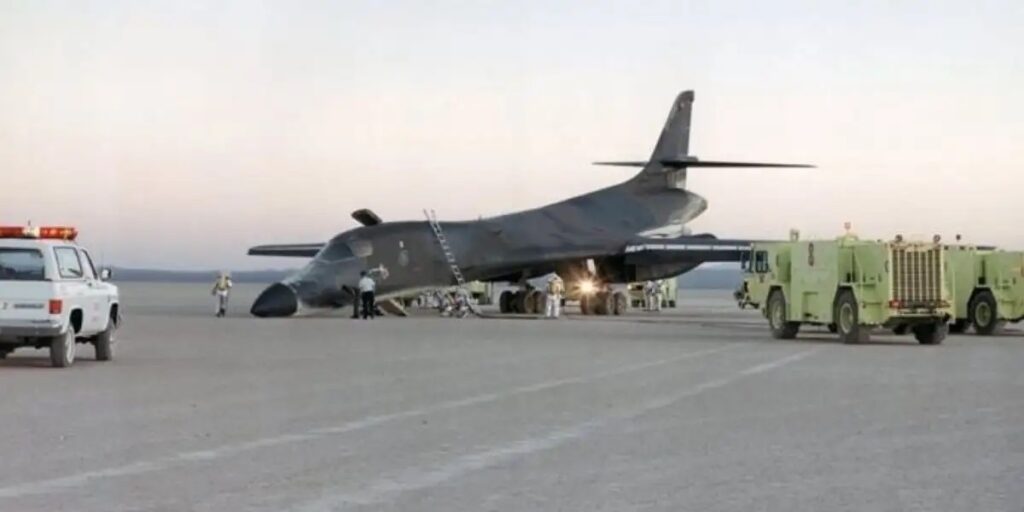
A dramatic emergency unfolded at Edwards Air Force Base when a U.S. Air Force B-1B Lancer bomber was forced to make an unusual and risky nose landing after experiencing a critical mechanical failure. The incident, while rare, highlighted both the inherent dangers of high-performance military aviation and the exceptional training of U.S. Air Force aircrews who operate some of the world’s most complex aircraft.
The B-1B Lancer, commonly known as the “Bone,” is a long-range, supersonic strategic bomber designed to deliver both conventional and nuclear weapons. With its variable-sweep wings, massive airframe, and advanced avionics, the aircraft is capable of flying intercontinental missions at low altitude and high speed. However, like all complex machines, it is not immune to mechanical problems—especially after decades of service.
The Emergency Situation
During what was believed to be a routine flight or test mission, the B-1 bomber encountered a serious landing gear malfunction. Reports indicated that the aircraft’s nose landing gear either failed to deploy fully or became completely inoperable. This type of failure presents a major challenge for pilots, as the nose gear is essential for maintaining balance, steering, and structural protection during landing.
Faced with limited options, the aircrew declared an emergency and coordinated closely with air traffic controllers and emergency response teams at Edwards Air Force Base. Edwards, known worldwide as a hub for flight testing and emergency recoveries, is uniquely equipped to handle such situations. Its long runways and dry lakebed landing areas make it one of the safest locations for handling damaged or malfunctioning aircraft.
Preparation on the Ground
As the B-1 circled the base to burn off excess fuel and reduce landing weight, emergency crews were positioned along the runway. Firefighters, medical teams, and aircraft recovery specialists stood ready, knowing that a nose landing could result in sparks, fire, or structural damage.
Pilots likely followed a carefully rehearsed checklist, preparing the aircraft for a controlled partial gear landing. This would have included adjusting airspeed, setting precise flap configurations, and positioning the aircraft to minimize stress on the fuselage when the nose eventually contacted the runway.
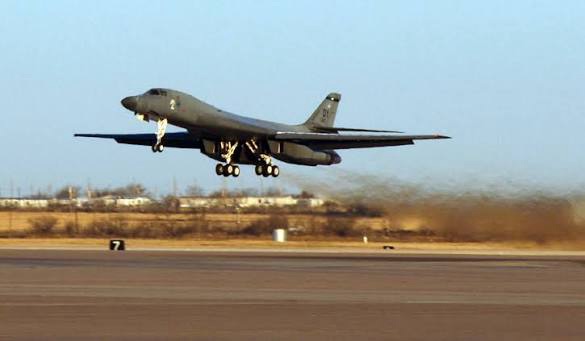
The Nose Landing
When the B-1 finally touched down, the main landing gear absorbed most of the initial impact. For a brief moment, the aircraft rolled forward normally, balanced on its main wheels. Then, as speed decreased, gravity took over. The bomber’s nose slowly dropped until the forward fuselage made contact with the runway.
Sparks were reported as metal scraped against concrete, a visually dramatic but expected outcome in such landings. Despite the alarming sight, the aircraft remained under control. Emergency crews immediately moved in once the bomber came to a complete stop, ensuring there was no fire and assisting the crew in safely exiting the aircraft.
Remarkably, no serious injuries were reported—a testament to both pilot skill and aircraft design.
Why Nose Landings Are So Dangerous
A nose landing is one of the most dangerous scenarios for any aircraft, especially a large bomber like the B-1. The forward fuselage is not designed to absorb landing forces, and critical systems—including radar, avionics, and crew compartments—are located near the nose.
Additionally, the risk of fire is high due to friction, potential fuel leaks, and exposed components. Even under ideal conditions, the margin for error is extremely small.
That the B-1 was able to land without catastrophic damage underscores the effectiveness of emergency procedures and the extensive training bomber crews receive.
The Role of Edwards Air Force Base
Edwards AFB has a long history of handling aviation emergencies. From experimental aircraft to frontline combat jets and heavy bombers, the base has seen nearly every type of airborne crisis imaginable. Its wide runways, open surroundings, and highly experienced personnel make it a preferred destination for emergency landings involving large or damaged aircraft.
In this case, Edwards’ infrastructure and readiness were crucial in preventing a potentially disastrous outcome.
Aftermath and Investigation
Following the incident, the aircraft was secured and inspected by maintenance and safety teams. An official investigation would likely focus on the exact cause of the landing gear failure, examining mechanical components, maintenance records, and flight data.
Such investigations are standard procedure and play a critical role in improving aircraft safety. Any findings would be used to update maintenance protocols, training procedures, or even aircraft modifications across the B-1 fleet.
Aging Aircraft, Ongoing Challenges
The B-1B Lancer entered service in the 1980s and has since been pushed far beyond its original mission profile. Once intended primarily for nuclear deterrence, the bomber has spent much of its later life flying conventional combat missions, often at low altitude and high stress levels.
As the aircraft continues to age, incidents like this highlight the challenges of keeping legacy platforms operational while maintaining safety. The U.S. Air Force has already begun transitioning toward newer bombers, such as the B-21 Raider, but the B-1 remains a vital part of the fleet for now.
Conclusion
The emergency nose landing of a B-1 bomber at Edwards Air Force Base was a dramatic reminder of the risks faced by military aviators every day—even during non-combat operations. Thanks to expert piloting, meticulous emergency planning, and the unique capabilities of Edwards AFB, a potentially catastrophic situation ended without loss of life.
While the incident will be studied closely to prevent future occurrences, it also stands as a powerful example of professionalism under pressure and the resilience of both aircrew and aircraft in the face of unexpected danger.
If you want, I can also:
Rewrite this in news style, documentary style, or Facebook-viral style Add technical details (landing gear systems, procedures) Make it shorter or longer for a specific platform