In December 1944, as World War II battles raged across the vast Pacific Ocean, the United States Navy was pushing forward with unstoppable force. Island after island had been taken. Supply lines stretched across thousands of miles. The skies roared with aircraft carriers launching strikes, and the sea was crowded with destroyers, cruisers, and battleships guarding the fleet like steel wolves. The war seemed to be turning in America’s favor. Yet, while enemy forces remained dangerous, the Navy was about to face a terrifying opponent that no gun could shoot down and no strategy could outmaneuver.
That enemy was nature itself.
What became known as Halsey’s Typhoon—or Typhoon Cobra—was one of the most devastating weather disasters in U.S. naval history. It was not a battle in the traditional sense. There were no Japanese ships firing shells and no fighter planes diving from the clouds. Instead, towering waves, hurricane-force winds, and chaos at sea struck with such violence that even the most powerful warships were brought to the edge of destruction. In a matter of hours, the storm crippled parts of the U.S. Navy and left behind wreckage, loss, and hard lessons that would change naval operations forever.
The Pacific War Machine
By late 1944, the U.S. Navy had become a giant of modern warfare. The aircraft carrier had proven itself as the new king of the sea, replacing the battleship as the fleet’s most valuable weapon. Task forces moved like floating cities, complete with fuel tankers, ammunition ships, escort vessels, and repair units. Everything depended on timing and coordination. A carrier without fuel was useless. A destroyer without supplies was vulnerable. The Navy’s ability to strike Japan depended on constant movement and constant resupply.
Admiral William “Bull” Halsey, a legendary and aggressive commander, led the U.S. Third Fleet. His reputation was built on bold action, relentless pressure, and speed. He was the kind of leader who believed the best defense was a crushing offense. Under his command, the fleet was operating near the Philippines, supporting major American operations and hunting Japanese forces wherever they could be found.
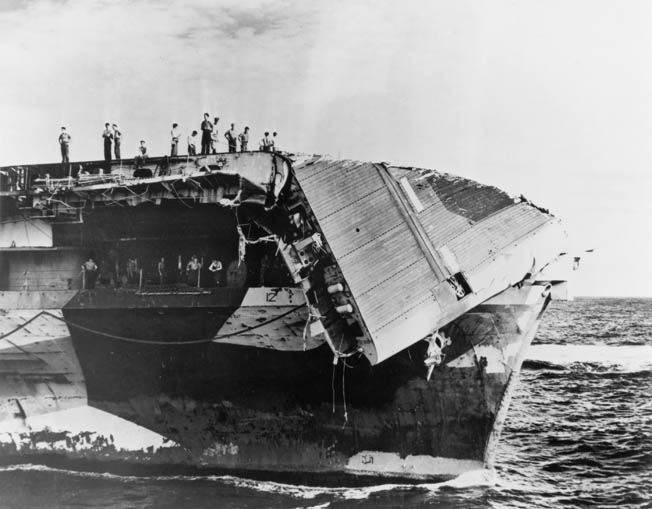
But war in the Pacific wasn’t just a fight against Japan—it was also a fight against geography and weather. The ocean was enormous, unpredictable, and unforgiving. Storms could appear quickly, and even advanced navies could be caught off guard. In 1944, weather forecasting at sea was far less accurate than today. Ships relied on scattered reports, limited data, and judgment calls that often had to be made under pressure.
The Fleet Sails Into Danger
In mid-December 1944, the Third Fleet was engaged in refueling operations. Refueling at sea was already dangerous in calm waters. Ships had to move close together, maintain steady speed, and connect fuel hoses while waves rose and fell. A slight mistake could cause collisions or broken lines. But it was essential. The fleet needed fuel to continue combat missions, and time was always running out.
As the refueling continued, a storm system began to grow in the region. What started as bad weather quickly developed into a powerful typhoon. The fleet received warnings, but the storm’s exact location and strength were unclear. The information available to commanders was incomplete. Worse, the typhoon moved in ways that made it difficult to predict. Halsey and his officers believed they could maneuver around it, staying just far enough away to avoid the worst.
They were wrong.
Instead of skirting the edge of danger, the Third Fleet sailed closer and closer to the typhoon’s heart. And when the storm finally struck, it hit with unimaginable brutality.
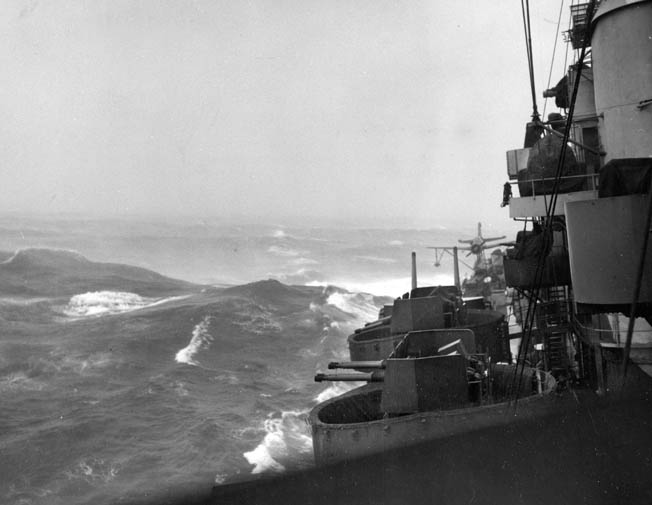
When the Ocean Turns Into a Monster
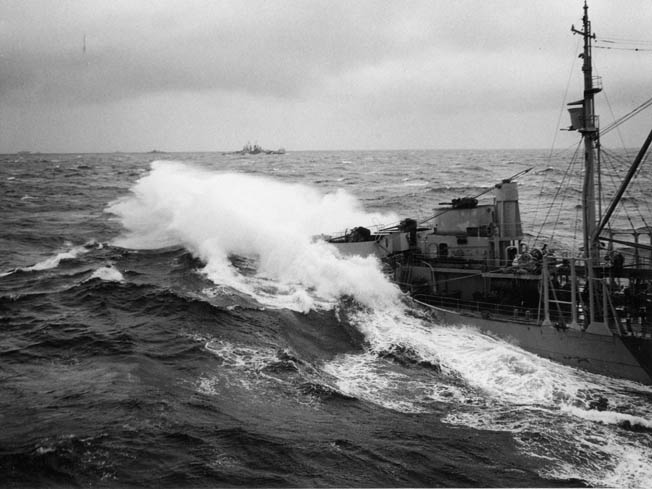
The winds reached speeds over 100 knots, strong enough to tear equipment from decks and bend metal. The sea became a battlefield of water—waves towering like moving cliffs. Ships rolled violently, some tilting at terrifying angles. Men clung to railings, ropes, and anything they could grab. Decks that once felt solid became slick death traps, swept constantly by seawater.
For smaller ships, especially destroyers, the typhoon was a nightmare beyond survival. Destroyers were fast and deadly in combat, but they were also relatively light compared to battleships and carriers. In extreme seas, their stability depended heavily on weight balance and fuel levels. Many destroyers were running low on fuel during the refueling operation, which meant their ships were lighter and more likely to capsize. Some also carried extra equipment and supplies that raised their center of gravity—making them even more vulnerable.
In the raging typhoon, three destroyers were lost:
- USS Hull
- USS Monaghan
- USS Spence
These ships didn’t sink from enemy fire. They were overwhelmed by nature. Violent rolling and massive waves flipped them, sending them into the ocean like toys thrown by a furious hand. Hundreds of sailors were suddenly in the sea, battling waves that could swallow a man instantly. Rescue was nearly impossible. Ships that tried to help risked being destroyed themselves.
In total, nearly 800 U.S. sailors died, many of them trapped inside sinking vessels or lost in the open ocean.
Even Giants Were Damaged
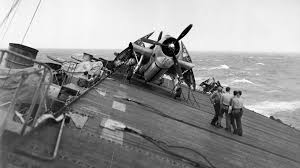
The typhoon didn’t only destroy smaller ships. Aircraft carriers—floating fortresses—were also badly damaged. Planes were ripped from their tie-downs and smashed into one another. Fires broke out on some decks. Equipment was thrown like shrapnel. Hangars flooded. Fuel lines ruptured. Entire squadrons of aircraft were destroyed without ever leaving the ship.
Some carriers lost dozens of planes in minutes. These were not minor losses—aircraft were critical to the Navy’s striking power. Losing them meant reduced combat effectiveness, delayed missions, and weakened air support for troops fighting on the islands.
Cruisers and battleships, while sturdier, were not immune. Many suffered structural damage, bent masts, and broken equipment. Communication became difficult. Navigation was nearly impossible. In the storm’s center, the fleet was scattered, with ships struggling just to stay afloat and avoid collisions.
For hours, survival became the only mission.
After the Storm: Shock and Reckoning
When the typhoon finally moved on, the ocean calmed enough for ships to regroup and search for survivors. What they found was heartbreaking. Oil slicks, floating wreckage, and scattered debris marked where ships had once sailed. Sailors were pulled from the water exhausted, injured, and barely alive. Many others were never found.
The scale of the disaster shocked the Navy. This wasn’t a defeat inflicted by Japan—it was a catastrophe caused by a deadly combination of poor weather information, risky positioning, and the sheer power of the Pacific.
An official investigation followed. Admiral Halsey faced serious criticism, and his decisions were questioned. While he was not removed from command, the incident left a permanent mark on his legacy. The Navy concluded that the fleet had been placed in unnecessary danger due to misjudgment and insufficient storm avoidance measures.
Lessons Written in Salt and Steel
Typhoon Cobra became a turning point. The Navy improved storm forecasting and weather reporting. Better communication systems were developed. Procedures for refueling and fleet movement were adjusted to reduce risk during severe conditions. Ship design and load management were also re-examined to improve stability in rough seas.
Most importantly, the disaster reminded commanders of a truth that war often hides: the ocean does not care who is winning. A fleet can dominate an enemy and still be helpless against nature.
The Storm That Became History
Today, Halsey’s Typhoon stands as one of the most dramatic examples of the sea’s destructive power. It is remembered not only because ships were lost, but because it showed how quickly control can vanish. One moment, the U.S. Navy was a powerful force pressing toward victory. The next, it was fighting for survival against waves taller than buildings.
In December 1944, the Pacific Ocean delivered its own attack—silent, merciless, and unstoppable. And the U.S. Navy, despite all its strength, learned that even the greatest fleet in the world can be brought to its knees by a storm.